Facing an HMRC Tax Investigation? Here’s What to Do
The sight of a “brown envelope” from HM Revenue & Customs (HMRC) on your doormat is enough to make any taxpayer’s heart skip a beat. Whether you are a small business owner, a high-net-worth individual, or a self-employed freelancer, the realization that your financial life is under the microscope can be paralyzing.
But here is the first thing you need to know: Received a letter from HMRC? Don’t panic. While an enquiry is serious, it is a manageable process provided you don’t walk into the lion’s den alone. In the modern tax landscape, tax investigation accountants are no longer a luxury; they are your primary line of defense. This guide will walk you through the mechanics of an investigation, the triggers that catch HMRC’s eye, and the strategic steps you must take to protect your assets and your reputation.
2. What is an HMRC Tax Investigation?
In technical terms, an HMRC tax investigation (or “enquiry”) is an official review of your tax affairs to ensure you are paying the right amount of tax at the right time. HMRC has statutory powers under the Finance Act to check any return you’ve submitted.
The Different Levels of Enquiry
Not all investigations are created equal. Understanding which “lane” you are in determines the level of risk:
- Full Enquiry: HMRC looks at the “whole” of the tax return. This usually involves a deep dive into all records, including personal bank statements if they suspect business and personal funds are intermingled.
- Aspect Enquiry: HMRC is only interested in one specific part of your return for example, a high claim for “travel expenses” or a discrepancy in capital gains from a property sale.
- Random Checks: Occasionally, HMRC’s system simply picks a name out of a hat. These are rare but serve as a quality control measure for the department.
- Fraud Investigation (COP8 and COP9): These are the heavy hitters. A Code of Practice 9 (COP9) investigation means HMRC suspects “deliberate” tax fraud. This is a specialized area where hiring tax investigation accountants is non-negotiable to avoid criminal prosecution.
How long does it last? An aspect enquiry might wrap up in 3–6 months. A full enquiry or a fraud investigation can drag on for 18 months to two years, depending on the complexity and the quality of your records.
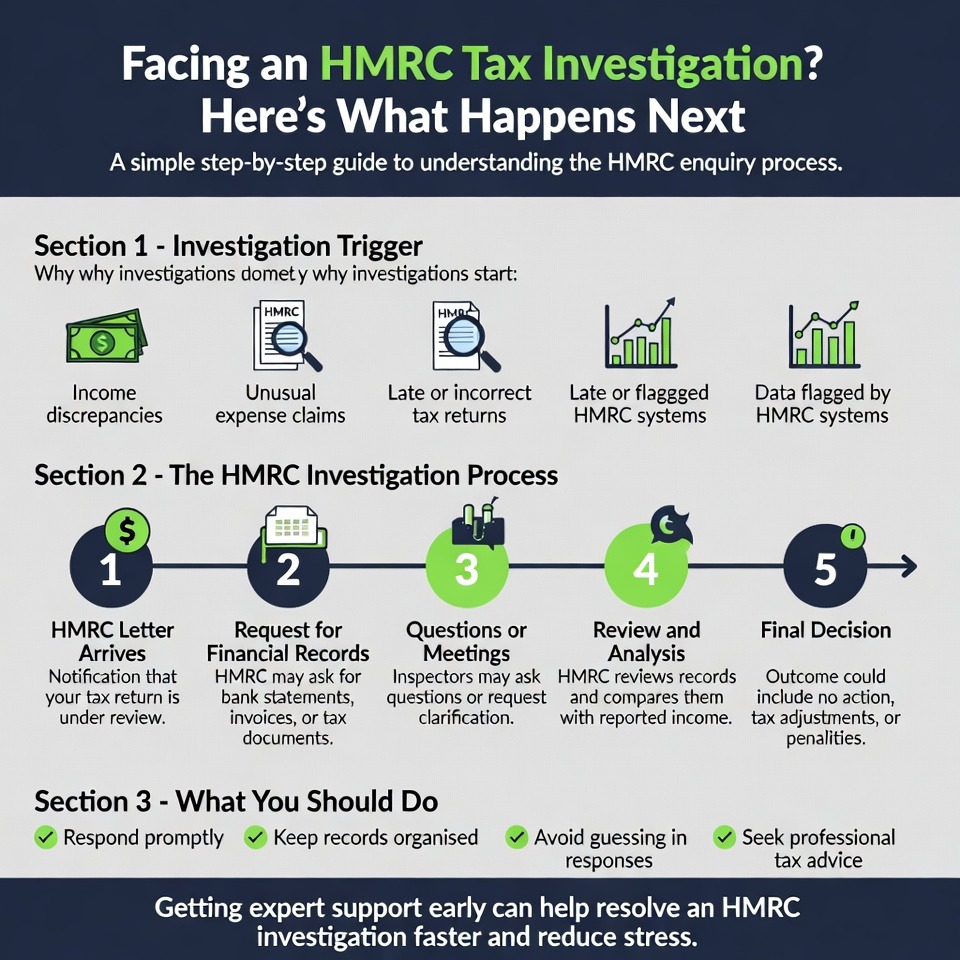
3. Why HMRC Investigates Taxpayers
A common misconception is that HMRC only investigates “criminals” or “tax dodgers.” In reality, perfectly honest taxpayers are flagged every day.
The “Connect” System: AI is Watching
HMRC uses a sophisticated data-matching tool called Connect. This software aggregates data from the Land Registry, bank accounts, credit card providers, and even social media. If you are posting photos of a brand-new Ferrari on Instagram but reporting an income of £20,000, the algorithm will flag the “lifestyle vs. reported income” discrepancy.
Modern Triggers
- Digital Platforms: HMRC now receives automatic data from Airbnb, Etsy, Vinted, and eBay. If you have a “side hustle” you haven’t declared, they likely already know about it.
- Crypto Gains: The “wild west” of crypto is over. HMRC has significant data-sharing agreements with major exchanges (Coinbase, Binance, etc.).
- Income Discrepancies: If your turnover stays exactly the same for three years, or your profit margins are significantly lower than the industry average, it triggers an “unusual pattern” alert.
4. Real-Life HMRC Investigation Scenarios
Case 1: The Self-Employed Oversight
A freelance graphic designer claimed “office expenses” for a home extension. HMRC’s AI flagged the high expense ratio compared to her turnover. What started as a simple enquiry turned into a full investigation of her last four years of records.
Case 2: The “Accidental” Landlord
A professional moved in with a partner and rented out their former flat. They didn’t realize that even if the rent just covered the mortgage, it still needed to be declared. HMRC used Land Registry data to spot the rental activity, leading to a demand for back tax and “failure to notify” penalties.
Case 3: The Crypto Enthusiast
An investor made significant gains in 2024 but didn’t realize that “swapping” Bitcoin for Ethereum is a taxable event. When they withdrew funds to their UK bank account in 2026, the bank flagged the large deposit to HMRC, triggering a COP8 enquiry.
5. Step-by-Step HMRC Investigation Process
Knowing the timeline helps remove the “fear of the unknown.”
- The Notification: You receive an official letter (usually under Section 9A of the Taxes Management Act) stating the years and taxes under review.
- The Information Request: HMRC will provide a list of documents they want to see (invoices, bank statements, payroll). You usually have 30 days to comply.
- The “Questions” Phase: After reviewing your documents, the inspector will ask for clarifications. They may request a “meeting” or interview. Note: You are not legally required to attend a meeting in person if your accountant can handle it in writing.
- The Findings: HMRC will issue a letter of intent, outlining what they believe is the underpaid tax, plus interest and penalties.
- Negotiation: This is where tax investigation accountants earn their keep. We argue the interpretation of tax law to reduce the liability.
- The Settlement: Once a figure is agreed, you sign a “letter of offer” and pay the amount (or set up a payment plan).
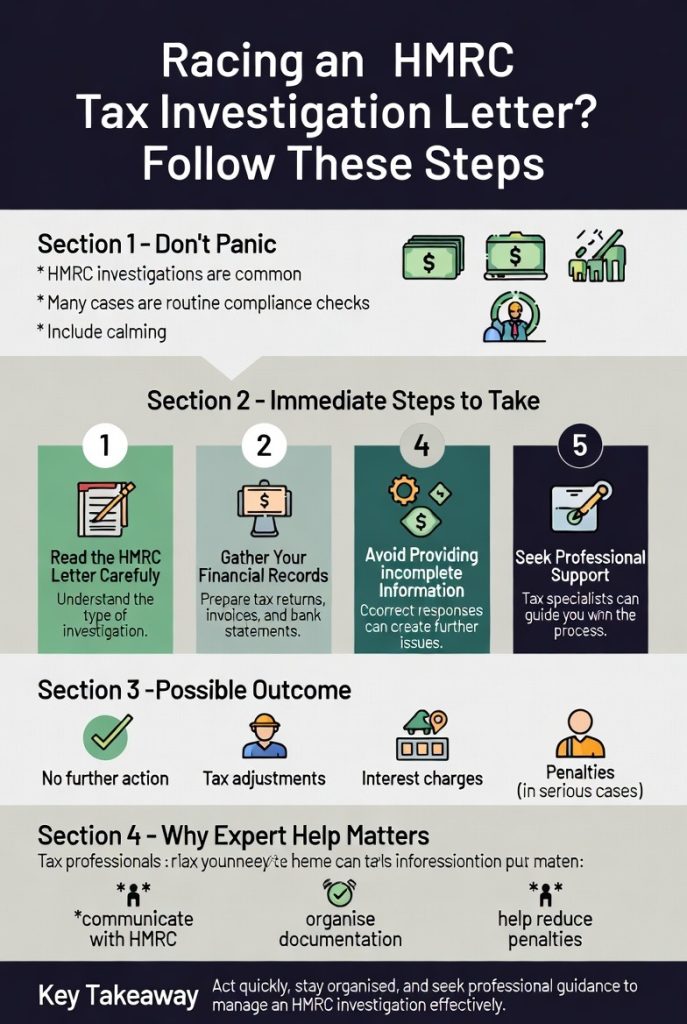
6. What To Do Immediately After Receiving an HMRC Letter
The moments after opening that letter are critical. Your actions here can either mitigate the damage or make it significantly worse.
The “Golden Rules”:
- Don’t Ignore It: HMRC has the power to issue “best judgment” assessments. If you don’t respond, they will simply tell you what they think you owe, and it will always be the highest possible figure.
- Don’t Contact the Inspector Directly: It is human nature to want to “explain things” and be helpful. However, anything you say can be used as evidence. A casual comment about your lifestyle can be interpreted as proof of undisclosed income.
- Gather Your Records: Pull together your bank statements and receipts, but do not send them yet.
- Hire a Specialist Tax Investigation Accountant: General accountants are great for filing returns, but they often lack the “adversarial” experience needed for an investigation. You need someone who knows exactly how far HMRC’s powers go and where they stop.
7. Consequences and Penalties
HMRC doesn’t just want the missing tax; they want interest and a “fine” for the error. Penalties are based on the behavior that led to the mistake:
| Behavior Type | Penalty Range (Unprompted) | Penalty Range (Prompted/Investigated) |
| Reasonable Care | 0% | 0% |
| Careless | 0% – 15% | 15% – 30% |
| Deliberate | 20% – 35% | 35% – 70% |
| Deliberate & Concealed | 30% – 100% | 100% – 200% (for offshore) |
Beyond the Money
If the investigation reveals a “deliberate” attempt to evade tax, HMRC can publish your name on their “deliberate defaulters” list. In extreme cases involving fraud, criminal prosecution and prison time are possibilities, though HMRC prefers civil settlements where they get the money.
8. How Tax Investigation Accountants Help
Why involve a specialist? Think of it like a legal trial; you wouldn’t represent yourself in court against a veteran prosecutor.
- Acting as a Buffer: We become the “Authorized Agent.” All HMRC correspondence goes to us. You don’t have to talk to them, and they can’t bully you into making snap statements.
- Managing the Scope: HMRC inspectors often ask for more than they are legally entitled to. We ensure the enquiry stays within its “Aspect” or “Full” boundaries.
- Technical Arguments: We use tax legislation and “case law” to prove that your expenses were legitimate or that an error was “careless” rather than “deliberate,” potentially saving you 50% or more in penalties.
- Negotiating Settlements: We know what HMRC is willing to accept. We can often negotiate “Time to Pay” arrangements if the final bill is large.
9. Reducing the Risk of Future HMRC Investigations
Prevention is the best cure. Once an investigation is closed, you are on HMRC’s radar for the next few years.
- Keep Digital Records: Use software like Xero or QuickBooks. Not only does this comply with Making Tax Digital (MTD), but it also makes it much harder for HMRC to claim your records are “incomplete.”
- The “Reasonableness” Test: Before submitting a return, ask: “Does this look right for my industry?” If you are a consultant claiming £10,000 in “sundries,” expect a letter.
- Disclose Everything: If you have a one-off gain, use the “white space” on your tax return to explain it. HMRC is less likely to investigate if the explanation is already there.
- Regular Consultation: Have your tax investigation accountants perform a “mock audit” of your books once a year to spot red flags before HMRC does.
How LANOP BUSINESS & Tax Advisors Can Help
Dealing with an HMRC enquiry can be overwhelming, but LANOP BUSINESS & Tax Advisors provides expert support to guide you through the process. As experienced tax investigation accountants, the team helps you understand the scope of the investigation, prepares accurate documentation, and ensures all responses to HMRC are handled professionally.
LANOP also manages communication with HMRC on your behalf, reducing the risk of mistakes and helping present your case clearly. If discrepancies arise, their specialists work to negotiate fairly with HMRC and aim to minimise potential penalties. With the right guidance and representation, LANOP helps make the investigation process less stressful while protecting your financial interests.
Frequently Asked Questions
1. Why has HMRC chosen to investigate me?
It could be random HMRC runs routine checks on a percentage of tax returns every year. Or it might be triggered by something specific: unusually high expenses, significant income changes, discrepancies between your return and third-party data, or working in a sector they’re currently targeting. Being investigated doesn’t automatically mean you’ve done something wrong.
2. What are the different types of HMRC investigations?
There are three main types. A full investigation examines your entire tax affairs over multiple years. An aspect inquiry focuses on a specific part of your return like business expenses or rental income. A random check is routine and not based on suspicion. The letter you receive will indicate which type you’re facing.
3. What should I do immediately after receiving an HMRC investigation letter?
Don’t panic, but don’t ignore it. Contact a tax specialist or accountant immediately ideally before responding to HMRC. Don’t try to handle it yourself, even if you think everything’s fine. Gather all relevant records: invoices, receipts, bank statements, contracts. And whatever you do, don’t destroy or alter any documents.
4. Can I handle an HMRC investigation on my own?
Technically yes, but it’s risky. HMRC officers are trained to ask questions that can inadvertently lead you to say something that complicates your case. A tax specialist knows what information to provide, how to present it, and what your rights are. They’ll handle all communication so you don’t make costly mistakes.
5. What records and documents will HMRC want to see?
They’ll typically request bank statements, invoices, receipts, contracts, business records, VAT returns, payroll documents, and correspondence related to the area under investigation. For self-employed individuals, they’ll want proof of income and expenses. Keep everything organized and only provide what’s requested no more, no less.
11. Conclusion: You Don’t Have to Fight Alone
An HMRC tax investigation is a stressful, time-consuming, and emotionally draining experience. It can feel like the weight of the state is leaning on your shoulders. However, most investigations end in a manageable settlement if handled correctly from day one.
The difference between a 70% penalty and a 0% penalty often comes down to the quality of your representation. Proactive, expert guidance is the only way to ensure that HMRC stays within their bounds and that you pay only what is legally required and not a penny more.
Don’t wait for the inspector to call again.
If you have received an enquiry letter or are worried about your past tax returns, contact LANOP Business & Tax Advisors. Our specialist tax investigation accountants have a proven track record of resolving complex enquiries, reducing penalties, and giving our clients their peace of mind back.Would you like us to review your HMRC letter and provide an immediate assessment of your risk? Contact Lanop today for a confidential consultation.